📅 Visited: January 2025
They shoveled sand over me until everything below my neck disappeared.
The first thing you notice is the weight.
Then a slow, spreading heat.
And after a little while, I could hear my pulse.
Wrists. Ankles. Thighs.
From the far ends of my body, through the sand, came a steady thud, thud, thud.

Honestly, there’s no better way to put it.
But still — this is a beach.
Why is the sand, right next to the sea, this hot?
The answer turned out to be scattered across the places we visited that day.
Michi-no-Eki Ibusuki — the rocks below beat the lookout
We picked up a rental car at Kagoshima Airport and headed south.
Just before Ibusuki, our first stop was Michi-no-Eki Ibusuki, one of Japan’s roadside rest stations.
There’s an observation deck, but what we found more interesting was the rocky shore you reach by walking down below it.
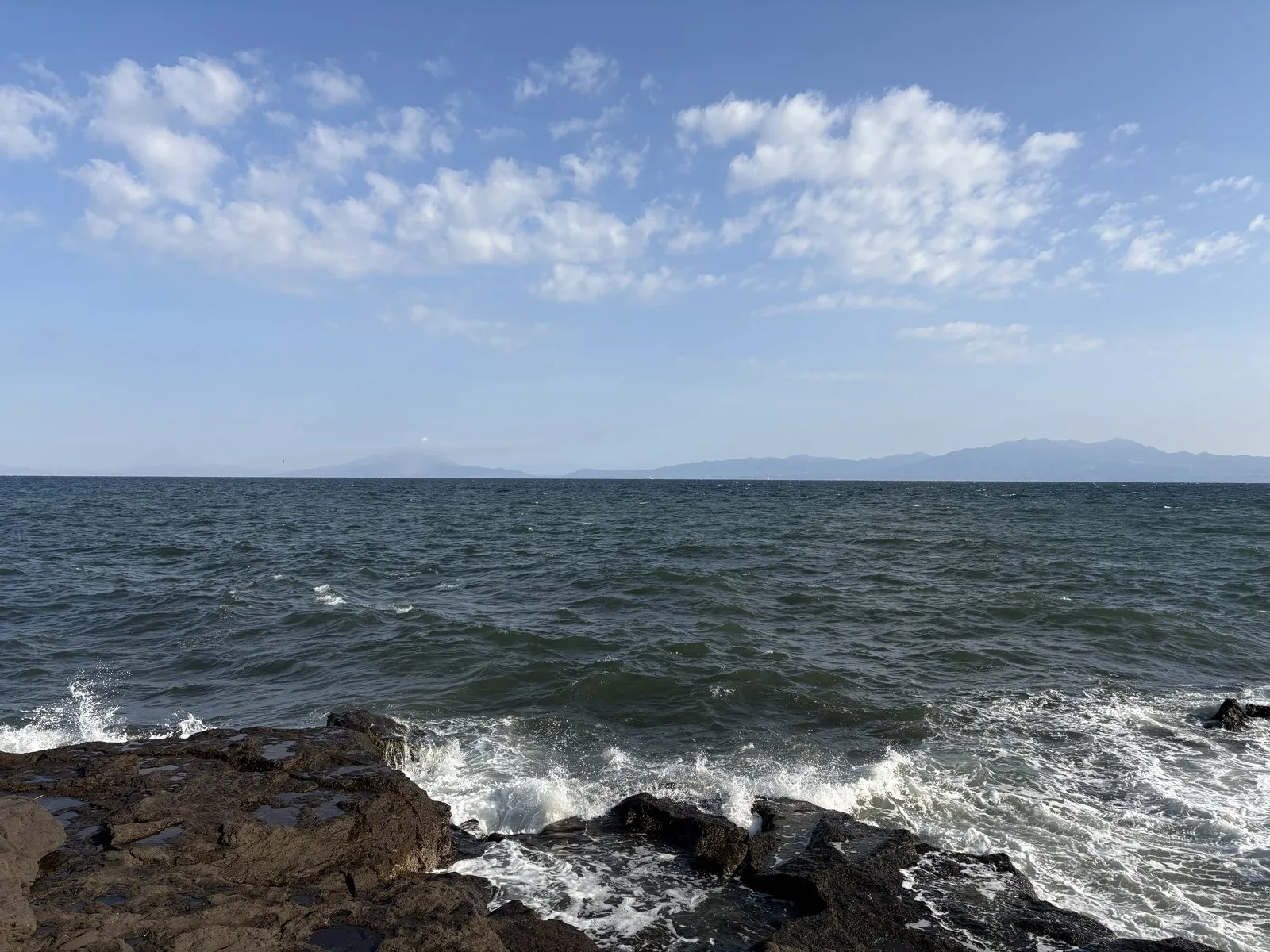
Dark rock juts out into the sea, and the waves slam into it with a splash.
After watching for a while, we noticed that the rock underfoot and the layer sitting on top of it were different colors.
Below: black, hard-looking rock.
Above: a rough, gritty layer, like sand and pebbles cemented together.
Probably gravel and sand piled up on top of old lava, we guessed, as we stood looking.
We don’t actually know.
What made it fun was simply how clearly you could see the line between the two.
Across the water we could make out the Osumi Peninsula, but Sakurajima was lost in the haze.
| Location | 52-4 Komaki, Ibusuki, Kagoshima |
| Parking | Yes (free) |
| Highlight | The rocky shore below the observation deck, where waves break against dark rock |
Michi-no-Eki Yamagawako Io-Kaido — bonito cutlets in a bonito town
For lunch we went to Michi-no-Eki Yamagawako Io-Kaido.
Yamagawa Port is a bonito town.
It’s known as a production area for katsuobushi, the dried bonito behind so much Japanese dashi.
I ordered the bonito cutlet set, and my wife got a bowl of glazed bonito with a soft-cooked egg, as a set with sashimi.
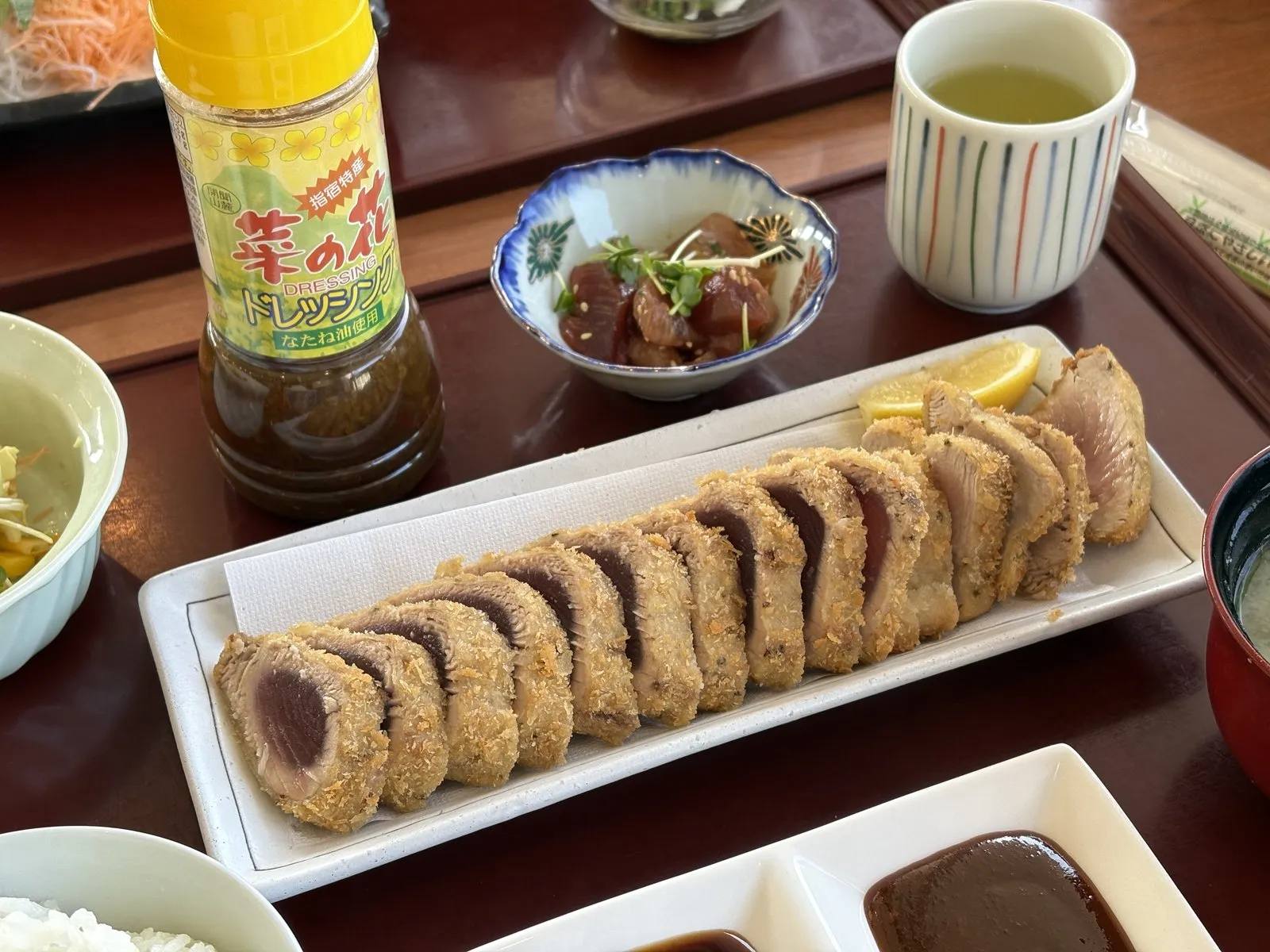
The bonito cutlet set was 1,100 yen, and apparently limited to 20 servings a day.
It came with a soup made from fish trimmings and a couple of small side dishes, and you can switch up the flavor as you go with lemon, sauce, or a miso dip.
That part was genuinely fun.
The sashimi set was 1,300 yen.
Both portions were generous, and we walked out completely full.
For the price, I’d call it a very good deal.
And the location of this rest stop, it turned out, would mean something later.
Yamagawa Port sits inside a round bay.
Why is that bay round?
We only understood that at the end of the day, looking down from a mountaintop.
| Location | 1-1 Yamagawa Shineicho, Ibusuki, Kagoshima |
| Parking | Yes (free) |
| Food | From 11:00. The bonito cutlet set is limited to 20 servings a day |
Finally, Mt. Kaimon
On the coast road toward the sand bath, my wife suddenly called out.
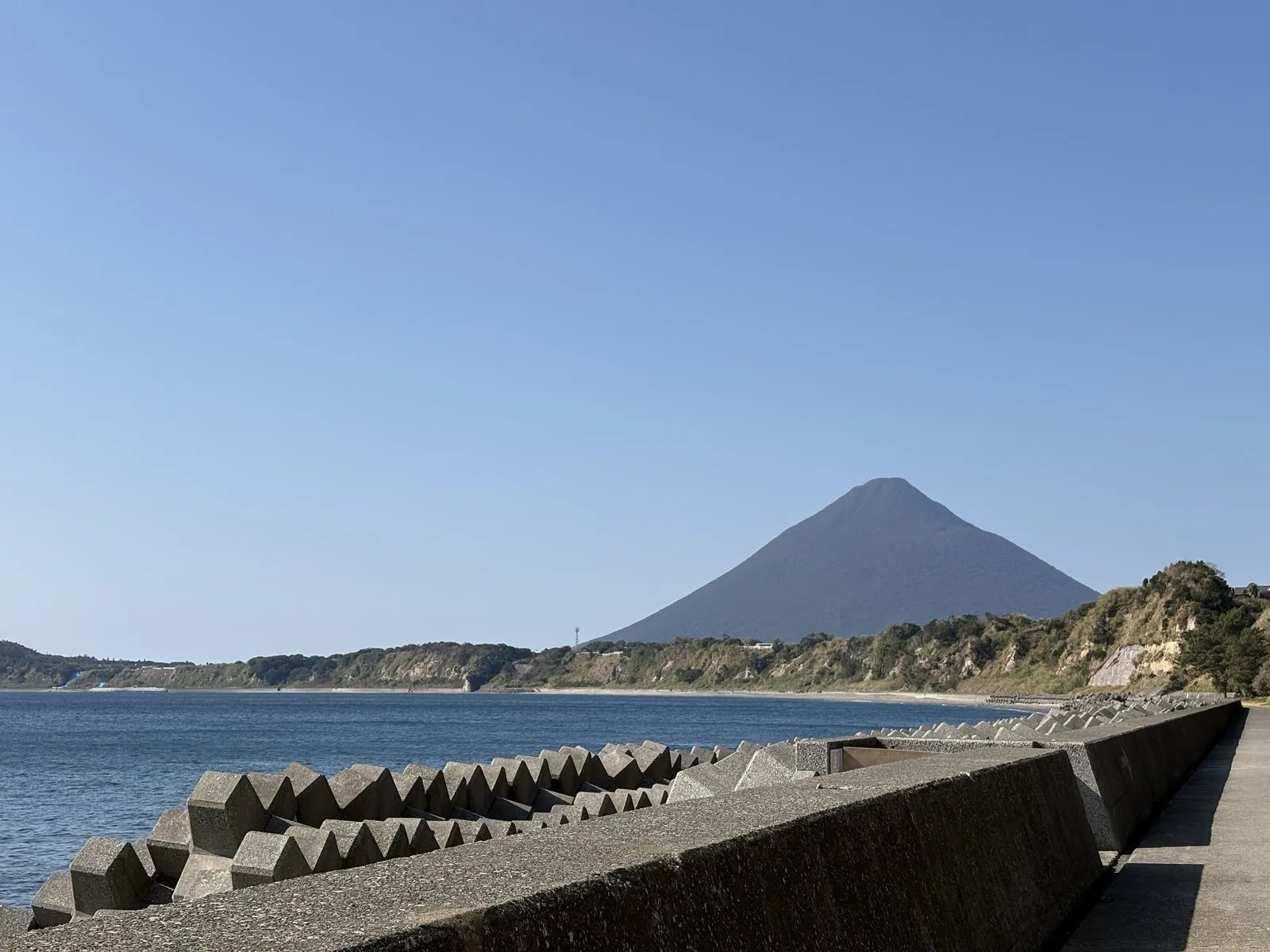
Beyond the seawall and the tetrapods stood a clean, triangular mountain.
Mt. Kaimon — Kaimondake.
All the way here it had kept hiding behind buildings and hills.
Which made it all the more satisfying when it suddenly slid into view right in front of us.
And beside it was a mountain of a completely different shape.

(Onigashima is the ogres’ island in the Momotaro folktale — the kind of place you’d picture as jagged and ominous.)
This one was craggy, dark, and saw-toothed along the top.
Standing next to smooth, triangular Kaimon, it looked even wilder.
We wouldn’t learn its name until the next day.
Yamagawa Sunamushi Onsen Sayuri — inside a full-body blood-pressure cuff
Now, back to the sand bath from the opening.
We’d arrived at Yamagawa Sunamushi Onsen Sayuri.
It’s a small sand-bath facility at the foot of a cliff facing the sea.
You change into a yukata (a light cotton robe) and lie down on the sand.
A staff member shovels sand over you.
Only your face stays out. Everything from the neck down is buried.
And then, just as I described at the start, the pulse arrives.
It starts at the extremities and gradually works its way toward the center.
Feeling your own pulse arrive in order, from the outside in, was something I’d never experienced before.
We were told about ten minutes is the guideline, but it felt so good that we stayed in for around twenty.
Or rather, I fell asleep partway through.
When I woke up, my yukata was soaked through.
You climb out, rinse the sand off in the shower, and that’s it.
To be honest, my takeaway isn’t “I want to come back every time.” It’s more “worth doing once.”
But that once was a once I remember vividly.
One practical tip.
Bring your own face towel, and go in planning to treat it as disposable.
It gets gritty with sand, and you use it to cushion around your face.
Bath towels were available to rent.
Afterward, we bought a Jam Monaka from Seika Foods at the shop and split it between us.
It’s vanilla ice cream with apple jam in a crisp wafer shell, made by the same company behind Bontan Ame candy.
Exactly what a body still glowing with heat wanted.
So, here’s the reveal.
Why is Ibusuki’s beach hot?
At Surigahama, the beach in central Ibusuki, hot spring water at around 80–90°C flows underground toward the sea.
But as it nears the shore, it runs into a layer of seawater that has seeped into the ground. This layer is called a saltwater wedge, because it pushes into the ground beneath the land like a wedge.
Blocked by that seawater with nowhere else to go, the hot water is said to well up close to the shoreline and warm the sand from below.
So where does that heat come from? The Ibusuki area is said to sit on the rim of the Ata Caldera, formed by a massive eruption about 110,000 years ago. The heat of that volcanic system is thought to still be warming the water underground today.
In other words, the heat I felt under the sand while listening to my own pulse may well be the warmth of an ancient volcano that hasn't finished cooling.
Sayuri sits on Fushime Beach, and it’s a separate sand-bath site from Surigahama in central Ibusuki.
We wanted to walk down to the shore just below, but it was off-limits that day.
| Location | 3339-3 Yamagawa Fukumoto, Ibusuki, Kagoshima |
| Parking | Yes |
| What to bring | Your own face towel (one you don't mind throwing away is handy). Bath towels available to rent |
| Note | About 10 minutes is the guideline. Seika Foods' Jam Monaka ice cream at the shop |
Nagasakibana — black lava shores and the best view of Mt. Kaimon
After the sand bath we drove to Nagasakibana, a cape at the southern tip of the Satsuma Peninsula.
There seemed to be an event nearby, and it was crowded.
Even so, once we walked out to the end of the cape, the view opened right up.
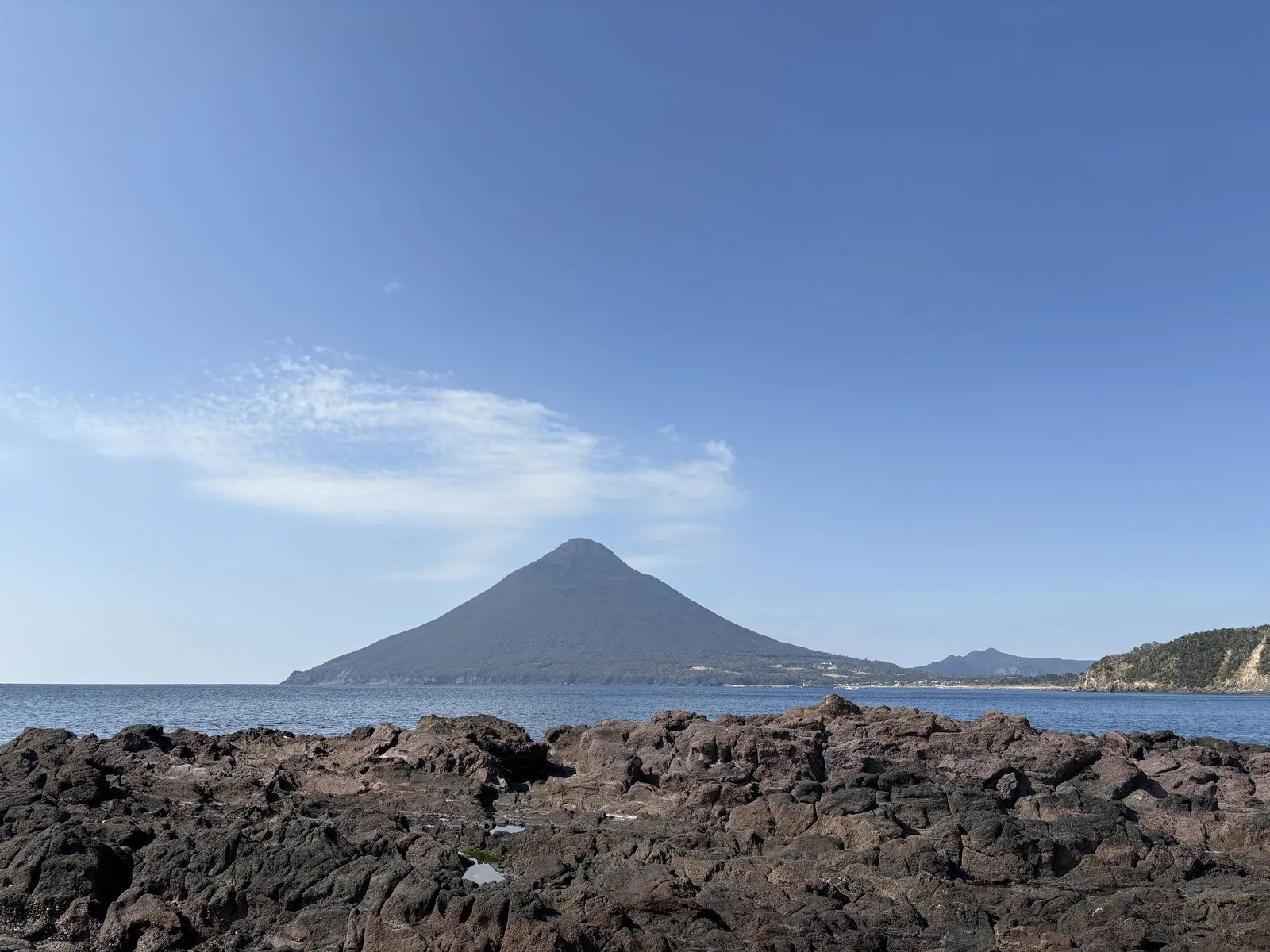
Black rocky shore, and beyond it, Mt. Kaimon.
Of all the views we had of it that day, this was the most beautiful.
The water was remarkably clear, and green seaweed swayed in the tide pools between the rocks.
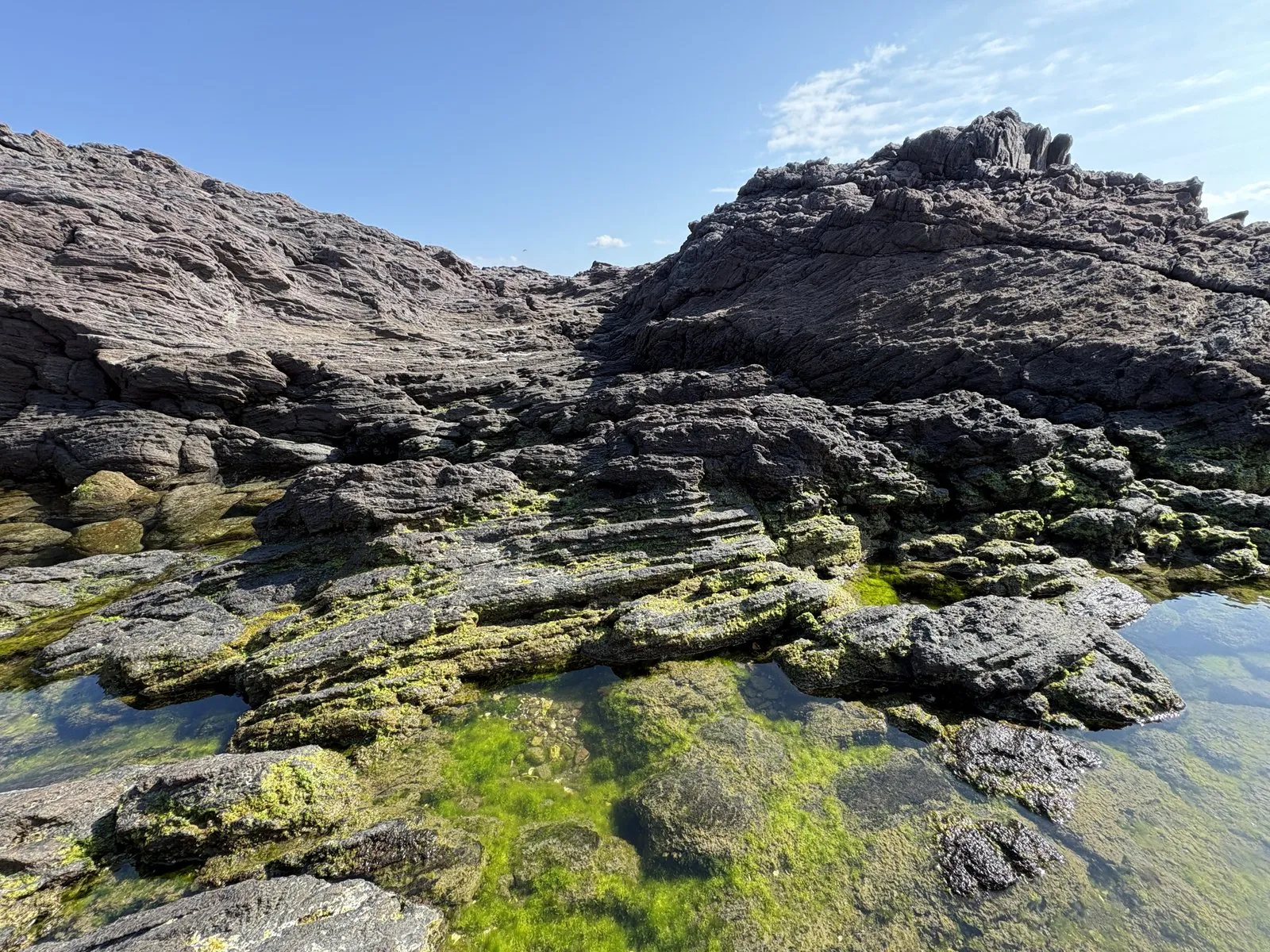
Looking closely, the rock had stripes running through it.
Black rock, those stripes, the green of the tide pools, and the triangular mountain beyond.
We walked as far as the lighthouse and stayed there a while, just looking.
As volcanoes go it's young — it's said to have begun erupting around 4,400 years ago.
In an eruption in 885 AD, a lava dome is said to have pushed up at the summit. That's thought to be why the mountain has a two-stage profile: gentle slopes lower down, and a steep section only near the top.
From a distance, you can make out a small bump sitting on top of the smooth triangle. That bump is the lava dome.
And the black rock of Nagasakibana, where we were standing, is said to be lava that flowed out from Mt. Kaimon and ran into the sea.
The rock under our feet and the mountain across the water, in other words, came from the same volcano.
| Location | Yamagawa Okochigamizu, Ibusuki, Kagoshima |
| Parking | Free municipal parking (roadside) |
| Highlight | Mt. Kaimon beyond the black lava shore. Tide pools and a lighthouse |
| Watch out for | The rocks are slippery. Crowded when events are on |
Nishi-Oyama Station and Sebira Park — change the angle, and the bump on top moves
From Nagasakibana we swung around to the west.
On the way we stopped at Nishi-Oyama Station, the southernmost station on the JR network.
Mt. Kaimon beyond the platform, rapeseed blossoms in the foreground.
It’s a famous composition.
And here, I noticed something.
At 924 m, it’s nowhere near the height of Mt. Fuji.
So a modest hill or a building is enough to hide it.
And every time it reappears, it looks a little different.
At our next stop, Sebira Park, that became obvious.
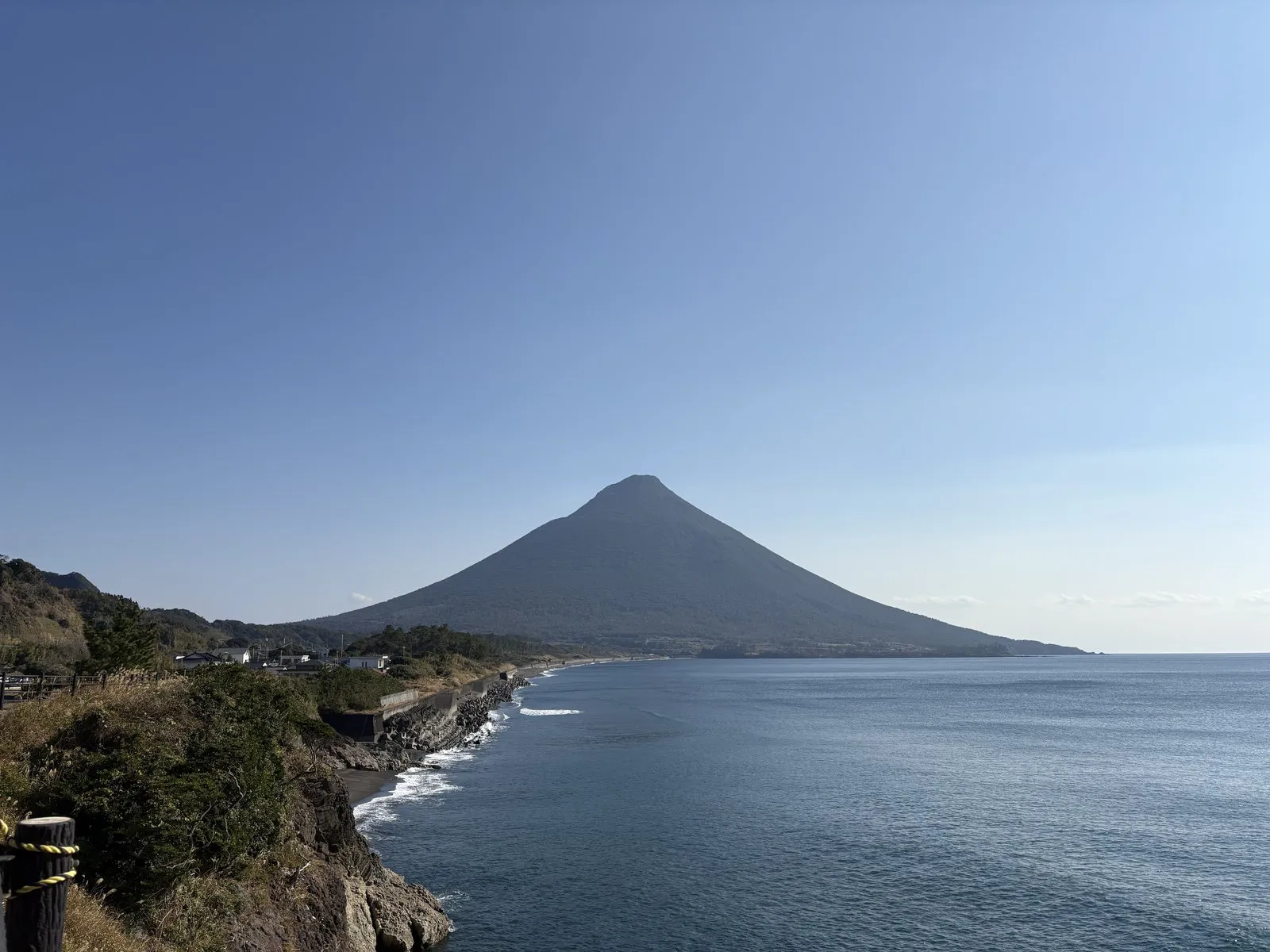
The coastline sweeps around in a gentle arc, and at the end of it, Mt. Kaimon.
Compared with the view from Nagasakibana, the little bump at the summit had shifted position.
The lava dome at the summit works as a kind of landmark.
A round, symmetrical mountain, and yet it shows a different “face” depending on where you stand.
Looking back, I think we spent the whole day chasing those different faces.
| Location | Ei-cho Kori, Minamikyushu, Kagoshima |
| Parking | Yes |
| Highlight | Mt. Kaimon at the end of an arcing coastline — a different angle from Nagasakibana |
Bandokorobana Nature Park — walking the rocks out toward the sea
A little farther west, we reached Bandokorobana Nature Park.
Here you can walk across the rocks right out toward the water.
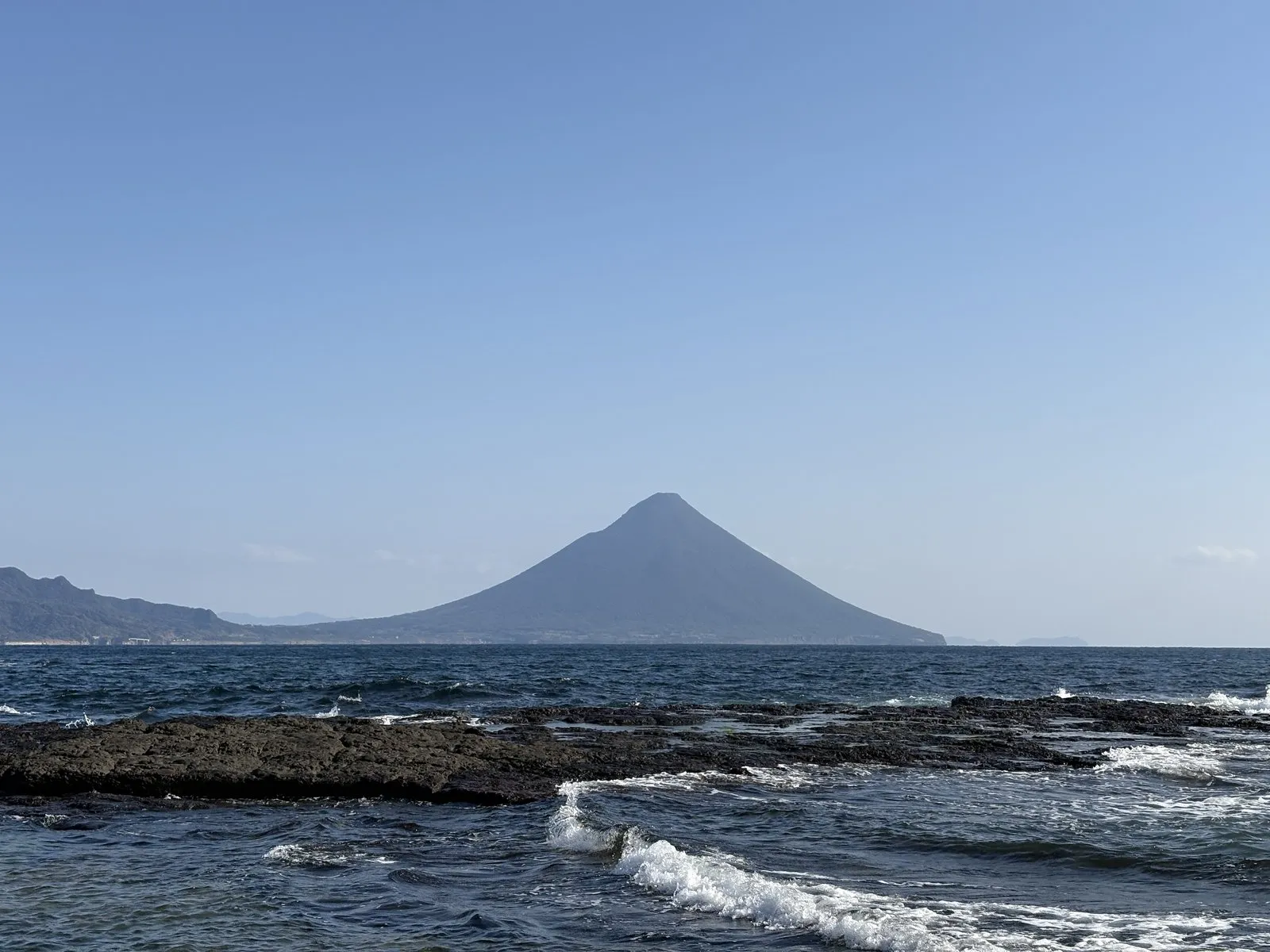
Waves roll onto the flat reef and break into white foam.
And beyond them, Mt. Kaimon once again.
Nagasakibana, Sebira Park, Bandokorobana.
The same mountain, seen from three different headlands.
Being able to walk on the rocks so close to the sea was what made this spot worthwhile.
| Location | Ei-cho Beppu, Minamikyushu, Kagoshima |
| Parking | Yes |
| Highlight | Walk across the rocks close to the sea. Waves and Mt. Kaimon |
| Watch out for | Watch your footing on the rocks. Stay back on days with high waves |
Onodake Park — the whole day’s volcanoes in a single frame
We’d planned to visit Mt. Ono (Onodake) on day two, but we had time to spare, so we moved it up.
Rain was forecast for the next day, so that turned out to be the right call.
You can drive all the way up to the observation deck.
From there, the view runs a full 360 degrees.
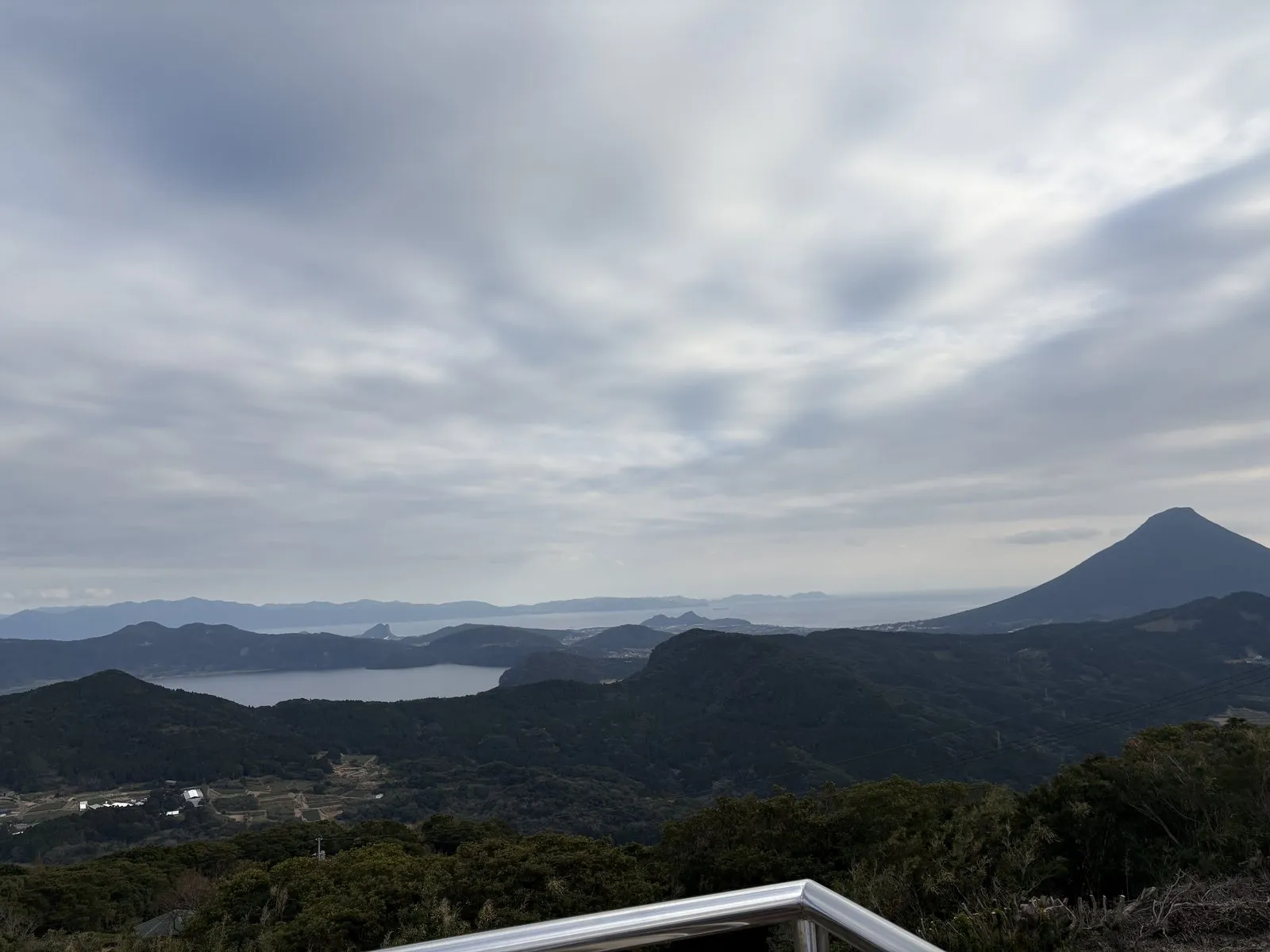
On the left, round Lake Ikeda.
On the right, triangular Mt. Kaimon.
You can see both at the same time.
Turn the other way, and the land slopes gently down from the mountains to the sea.
The road we took afterward down to Lake Ikeda was lined on both sides with tea fields, mile after mile.
This is where Chiran tea and Ei tea are grown.
Here, everything we’d seen that day finally clicked into one picture.
After a huge volume of magma was blasted out all at once, the ground dropped into the emptied space below, and water collected in the hollow. That's thought to be why the lake is round.
Around the same time, a series of phreatomagmatic explosions — blasts that happen when rising magma meets water underground — is said to have occurred in the surrounding area. The round craters these explosions leave are called maars, and Yamagawa Bay and Lake Unagi are both said to be maars.
So the round bay where we'd eaten lunch at Yamagawa Port was, it seems, a volcanic crater that the sea had flooded.
From Onodake you can take in round Lake Ikeda, the cone of Mt. Kaimon, and Yamagawa Bay in front of them in a single sweep.
All the volcanic landforms we'd spent the day driving between fit into one frame from up here.
| Location | Ei-cho Kori, Minamikyushu, Kagoshima |
| Parking | Yes (you can drive up to the observation deck) |
| Highlight | A 360-degree view with Lake Ikeda and Mt. Kaimon side by side. Tea fields on the other side |
Lake Ikeda — rapeseed in full bloom
Down from the mountain, we went to the shore of Lake Ikeda, which we’d just been looking at from above.
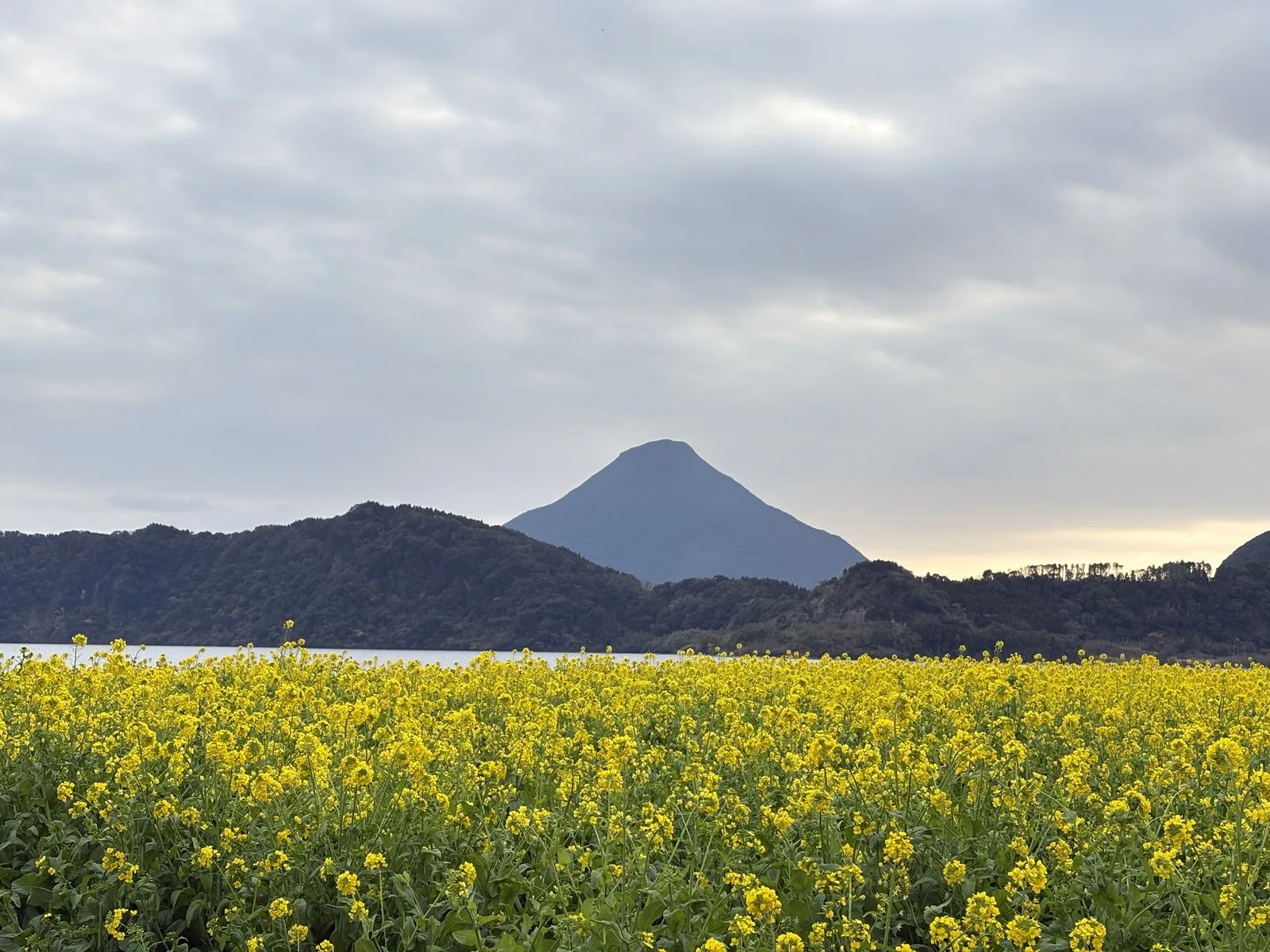
It was the end of January, and the rapeseed was in full bloom.
Beyond the yellow field, the lake, and Mt. Kaimon.
In Ibusuki, the rapeseed season comes much earlier than on Honshu, Japan’s main island.
With rain forecast for tomorrow, we kept telling each other how glad we were to have caught this today.
| Location | Ikeda, Ibusuki, Kagoshima |
| Parking | Available on the lakeshore |
| Highlight | Rapeseed blooms from January. Flower fields, the lake, and Mt. Kaimon together |
Satsuma-aji — kibinago and satsuma-age straight from the fryer
For dinner we’d booked a restaurant called Satsuma-aji in central Ibusuki.
When I called to reserve, the person on the phone was extremely courteous and suggested setting aside their popular dishes for us in advance.
That turned out to be a very good thing.
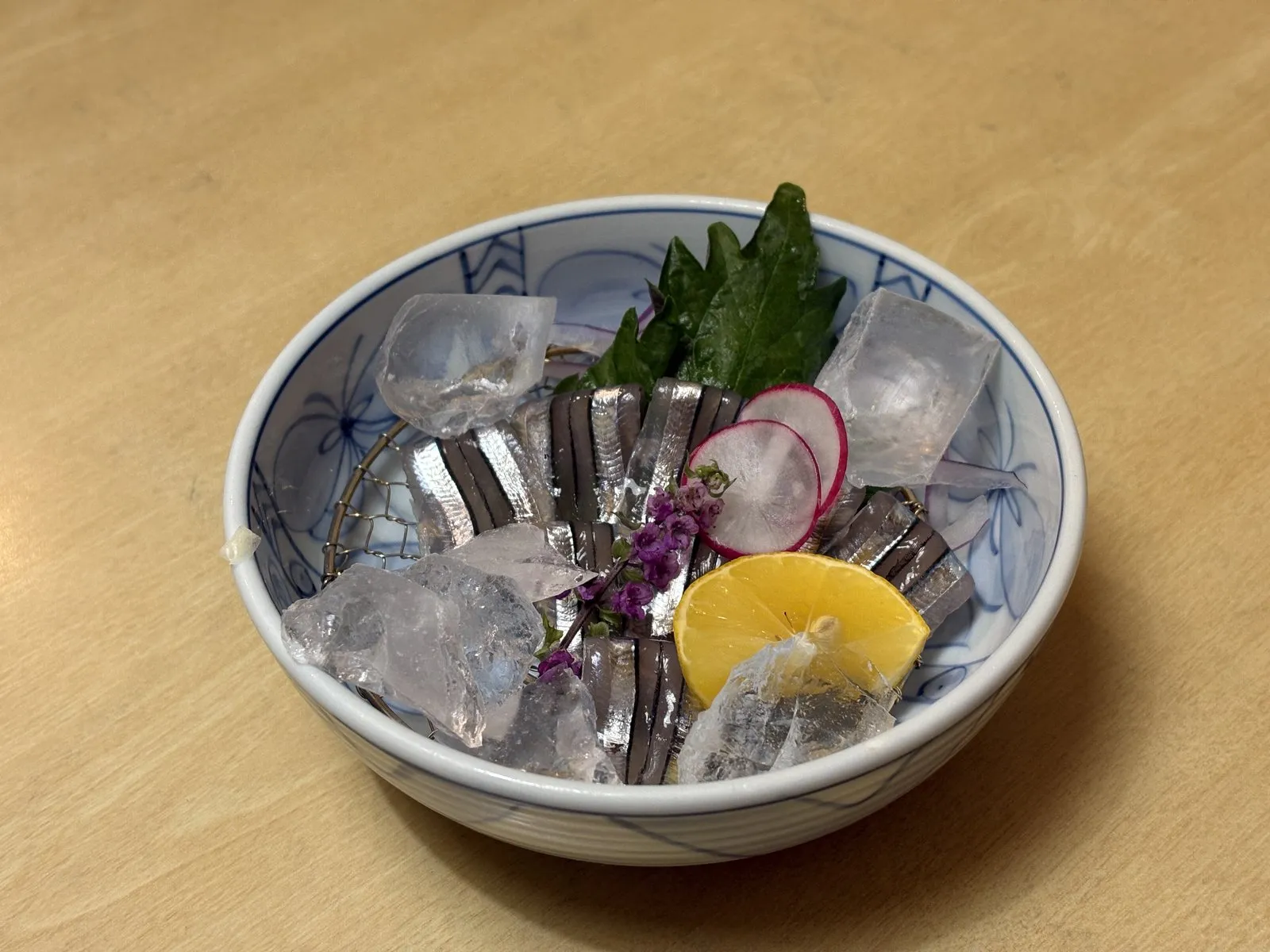
Kibinago sashimi, 1,100 yen.
Kibinago is a small silver-striped fish that’s a Kagoshima specialty. They’d apparently already sold out that day, so we only got to eat it thanks to the reservation.
The silvery fillets were laid out like flower petals.
It was simply beautiful to look at, and we ate it with vinegared miso.
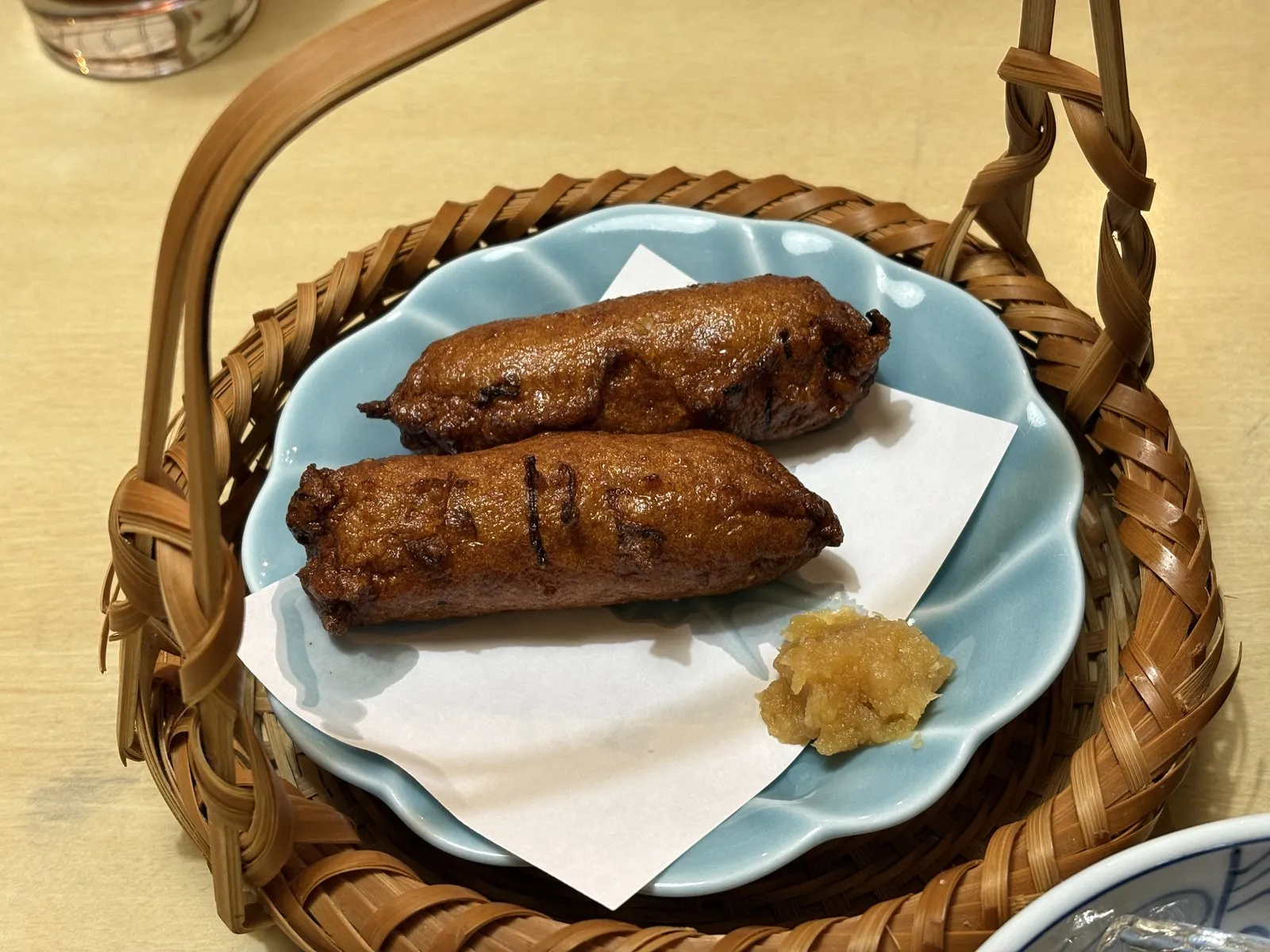
Then satsuma-age — Kagoshima’s fried fish cake — straight from the fryer, 660 yen.
Piping hot, with kelp mixed in, eaten with grated daikon radish.
Because it was freshly fried, it wasn’t greasy at all, and the outside was crisp.
We also had kurobuta tonkotsu (Kagoshima black-pork spare ribs simmered in miso) for 880 yen, satsuma-jiru soup for 420 yen, and battera (pressed mackerel sushi) for 980 yen.
Everything tasted distinctly of Kagoshima — just the right dinner to close out the day.
| Location | 2-1-31 Minato, Ibusuki, Kagoshima |
| Reservations | Recommended. Popular dishes can sell out, so it's worth asking about setting some aside when you book |
| Signature | Kibinago sashimi, freshly fried satsuma-age, kurobuta tonkotsu |
Ibusuki Hakusuikan — spacious, and a long walk to the bath
We stayed at Ibusuki Hakusuikan, in a twin room in the Hana wing.
Spacious and clean.
And a very long way from the baths.
The grounds are so big that you walk and walk down the corridors and still haven’t arrived.
Breakfast was a buffet with a spread of Kagoshima specialties.
Akumaki, fukure-gashi, bonito belly, bonito miso.
Getting to eat local food at breakfast is one of the small pleasures of traveling.
Day two — Uomidake in the rain, and a tea break in Chiran
Day two brought rain, just as forecast.
Even so, we drove up to the Uomidake observation deck.
It’s a lookout that Tamori, the TV personality, has also visited on his show.
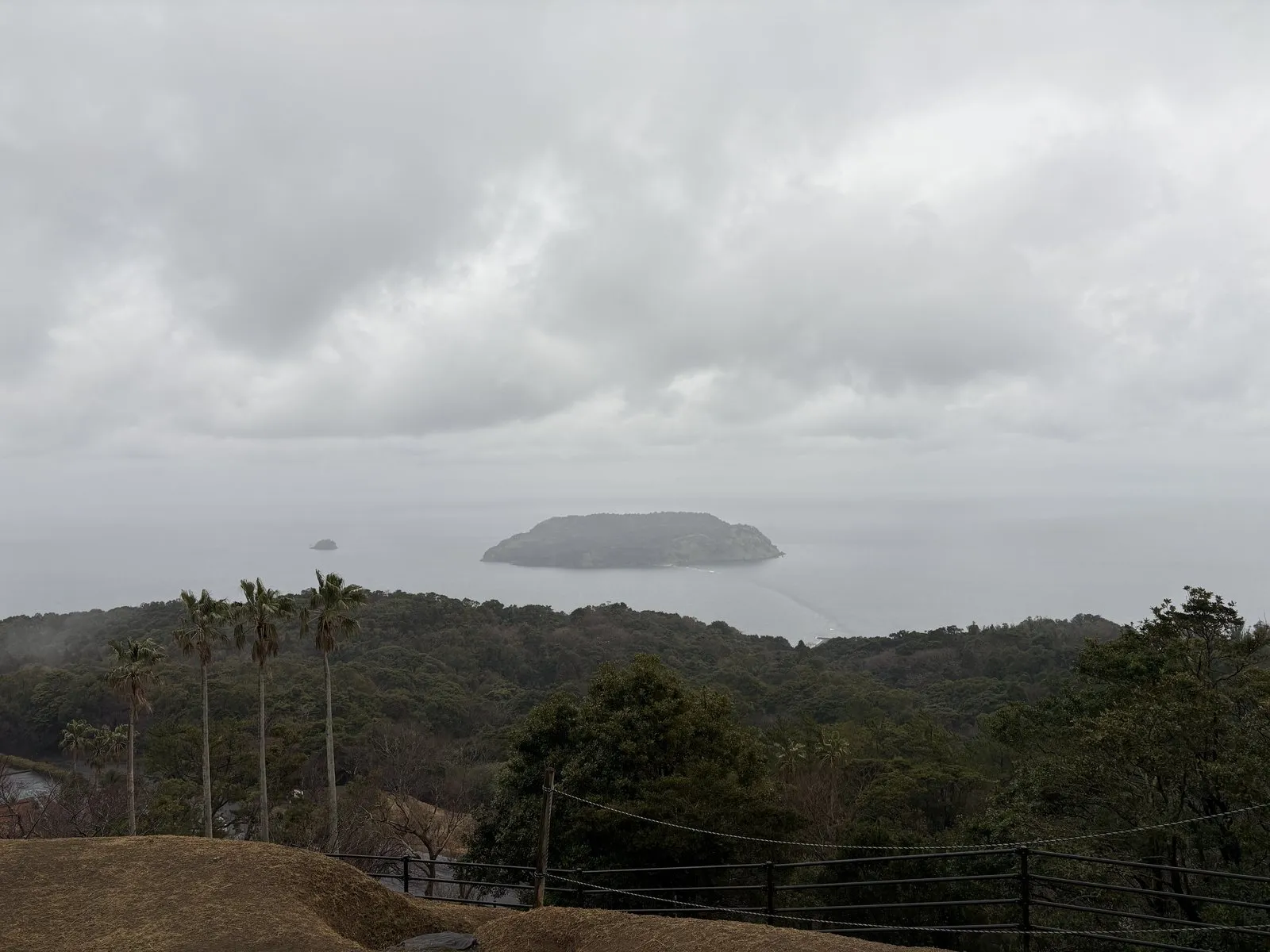
Even in the rain, we could see the town of Ibusuki and Chiringashima floating in the sea.
Chiringashima is said to be connected to the mainland by a sandbar at low tide.
That day, too, we could faintly make out the strip of sand.
And here, one of yesterday’s questions got its answer.
That craggy mountain we’d seen next to Mt. Kaimon.
This is where we learned its name: Takeyama.
| Location | Higashikata, Ibusuki, Kagoshima |
| Parking | Yes |
| Highlight | Central Ibusuki and Chiringashima. At low tide you can see the sandbar leading to the island |
From there, we went on to Chiran.
We visited the Chiran Peace Museum, dedicated to the kamikaze pilots, and afterward walked along the street of old samurai residences.
In the rain, the stone walls and hedges along the samurai street were dark and wet, and everything was quiet.
We took a break at Takajo-an, a teahouse on the street.
Jambo mochi — rice cakes on twin skewers — and chabushi.
Chabushi is miso and bonito flakes with Chiran tea poured over them.
A simple drink, a bit like having only the tea from a bowl of ochazuke, and it went straight to the bones after the cold rain.
Here we were, drinking tea from the very fields we’d looked down on from Onodake the day before.
A rainbow at Kagoshima Airport
At Kagoshima Airport on the way home, the rain finally stopped.
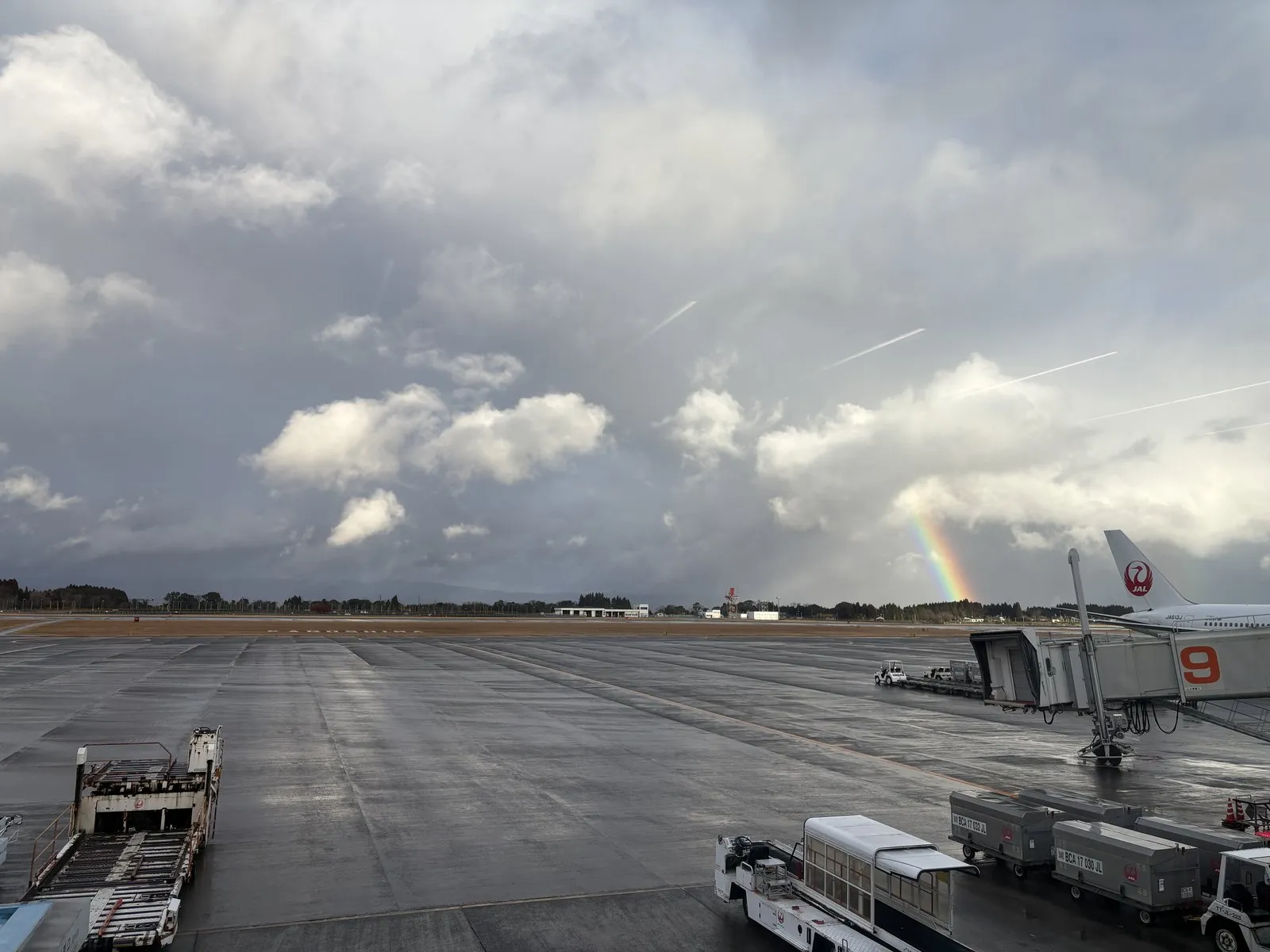
A rainbow hung over the far side of the runway.
At the end of a rainy day, it felt like a small parting gift.
Looking back, most of this trip was packed into day one.
The rocks below the rest stop, the bonito cutlets, the sand bath, Mt. Kaimon from three headlands, the view from Onodake, Lake Ikeda in rapeseed bloom, kibinago and satsuma-age.
Scenery, hot springs, and food, all folded compactly into a single day.
And then there was learning that the heat I’d felt under the sand is thought to come from an ancient volcano.
That the round lake, the triangular mountain, and even the round bay where we ate lunch were all, it seems, the work of volcanoes.
You can enjoy these views without knowing any of that. But once you know, they start to look a little different.
It’s not somewhere I’d go every year, but I’d like to come back once I’ve half forgotten it.
A sand bath feels like something you can keep enjoying as you get older.
And when I do come back, I expect I’ll be lying under the sand again, counting my pulse, and drifting off to sleep.
Geological references: Geological Survey of Japan, AIST, "Large-scale Eruption Database" (Ikeda Caldera, Ata Caldera); Japan Meteorological Agency volcano descriptions for "Kaimondake" and "Ikeda and Yamagawa"; Ibusuki tourism website "Ibusuki Kanko Net" (sand baths). Statements written as "is said to" or "is thought to" reflect prevailing interpretation and estimation rather than settled fact.